Posts in General Interest
CADENCE (R.P.M.)

For those who love to Google, there is a wealth of good, not-so-good,                                              and absolute  rubbish

advice on the subject of cadence, Some articles are very convoluted and delve into use of power meters and other objective measures of output at various cadences,. Others recommend observation of a number of professional cyclists, and still others tie in the efficiency of various rpm's with age.

One of the best pieces of advice for the majority of those seeking to find their ideal pedalling rate is by Rich Strauss on the Beginner Triathlete web site here. Rich provides plenty of common sense information, tips and examples in an easy-to-understand style. Well worth reading.

For what it's worth your editor's advice is: if your lungs hurt more than your legs, pedal slower, if your legs hurt more than your lungs, increase your cadence.

YOUTH COACHING COURSES ON VANCOUVER ISLAND

Colin Chapman (not the one of Lotus fame) is Cycling BC coordinator for youth programmes. He has indicated that, as part of the provincial association's Youth Development Programme, there will be a number of youth coaching  courses, recognised by the NCCP (National Coaching Certification Programme). Some of these workshops will be held on Vancouver Island and hopefully there will be one in Nanaimo.

Any local road riders who are retired or can adjust their work hours so that they can visit schools as part of MIVA's youth programme, are invited to apply for a space at one of these free clinics. Once participants have certification as youth coaches they should have easy access to schools to help deliver the programme.

For further information, contact pakamac@gmail.com or call 250-244-1779.

PACK RIDING FOR THE LADIES

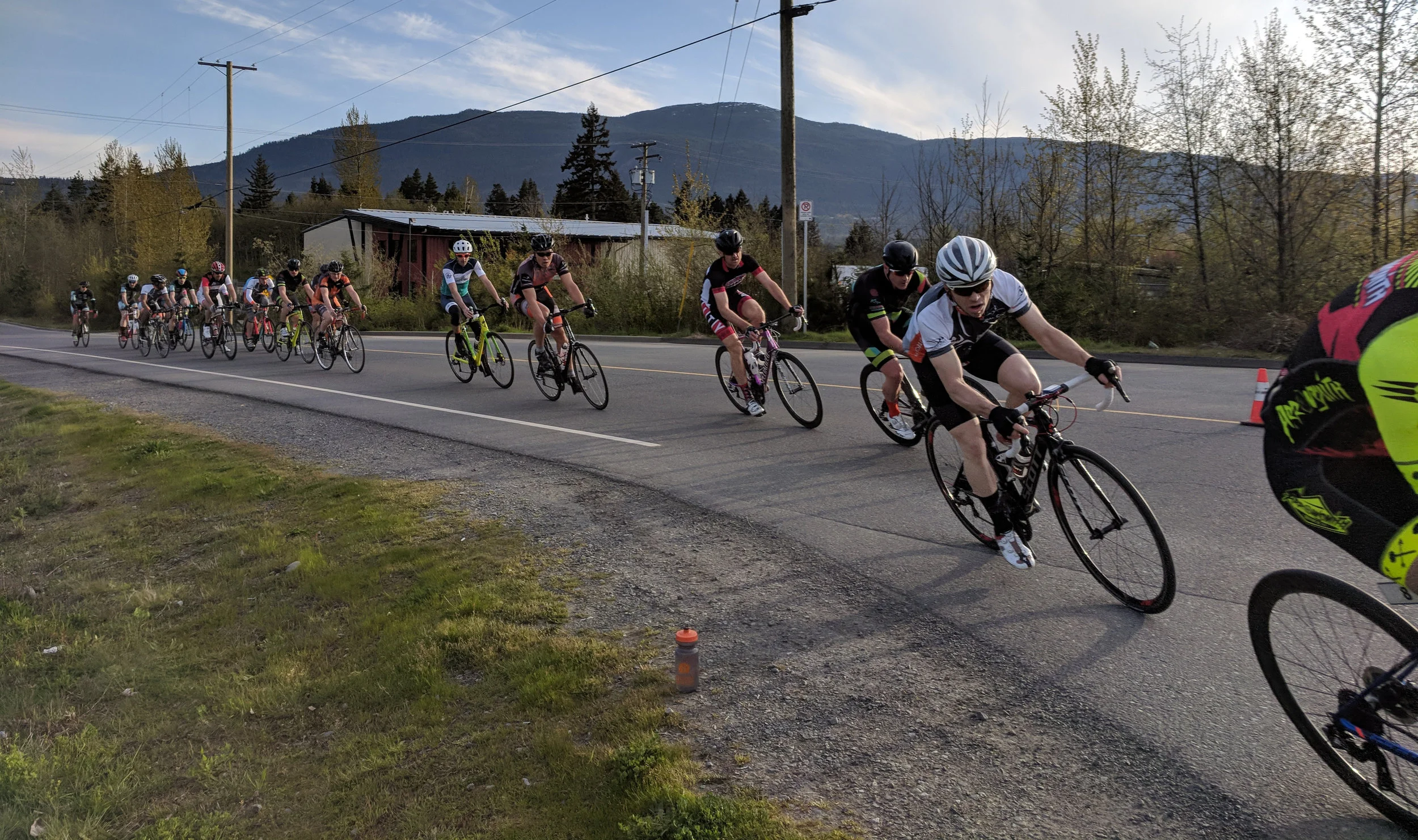
Janna Gillick, MIVA's Directeur Sportif Feminin, will shortly be electronically circulating a questionnaire to the ladies asking for their input re. club activities and racing geared towards women. Here is a video of the women's criterium in the Tour de White Rock, courtesy of Canadian Cyclist showing a ladies pack riding safely and fast. For all those girls who are somewhat squeamish about riding in a bunch and following fellow cyclists fairly closely, Janna's survey should provide some material for the club to institute some effective workshops to teach pack riding skills and to build confidence.

SUNDAY RACES IN MARCH / APRIL

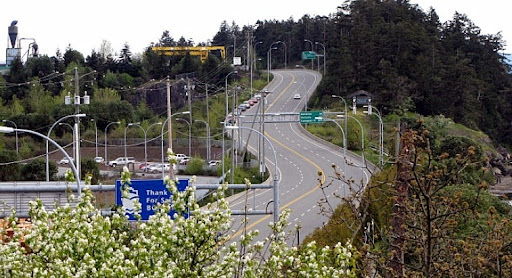
MIVA is applying to the City of Nanaimo for a permit to use the Duke Point Highway for Sunday time trials on March 4th. and 18th. and on April 4th. This may be possible as the Duke Point ferry terminal is closed for repairs until further notice. The April 4th. event may be changed to a 45km road race if there is sufficient interest.

This should be a great opportunity for Island roadies and tri guys to measure their pre-season form on a well-surfaced, traffic-free course. It's not often that you get the opportunity to race on the Trans Canada Highway!

Watch for updates.


PENNY FARTHING BICYCLES

Penny-farthing, high wheel, high wheeler, and ordinary are all terms used to describe a type of bicyclewith a large front wheel and a much smaller rear wheel that was popular after the boneshaker, until the development of the safety bicycle, in the 1880s. They were the first machines to be called "bicycles". Although they are now most commonly known as "penny-farthings", this term was probably not used until they were nearly outdated; the first recorded print reference is 1891 in Bicycling News.[3] It comes from the British penny and farthing coins, one much larger than the other, so that the side view resembles a penny leading a farthing. For most of their reign, they were simply known as "bicycles". In the late 1890s, the term "ordinary" began to be used, to distinguish them from the emerging safety bicycles, and this term or Hi-wheel (and variants) is preferred by many modern enthusiasts.

About 1870, James Starley, described as the father of the bicycle industry, and others began producing bicycles based on the French boneshaker but with front wheels of increasing size, because larger front wheels, up to 1.5 m (60 in) in diameter, enabled higher speeds on bicycles limited to direct drive. In 1878, Albert Pope began manufacturing the Columbia bicycle outside of Boston, starting their two-decade heyday in America.

Although the trend was short-lived, the penny-farthing became a symbol of the late Its popularity also coincided with the birth of cycling as a sport. There are still many of these unwieldy bikes around the world and a number of enthusiasts actually compete in races.  Here is a video of penny farthing races held in Evandale, Tasmania every year.