
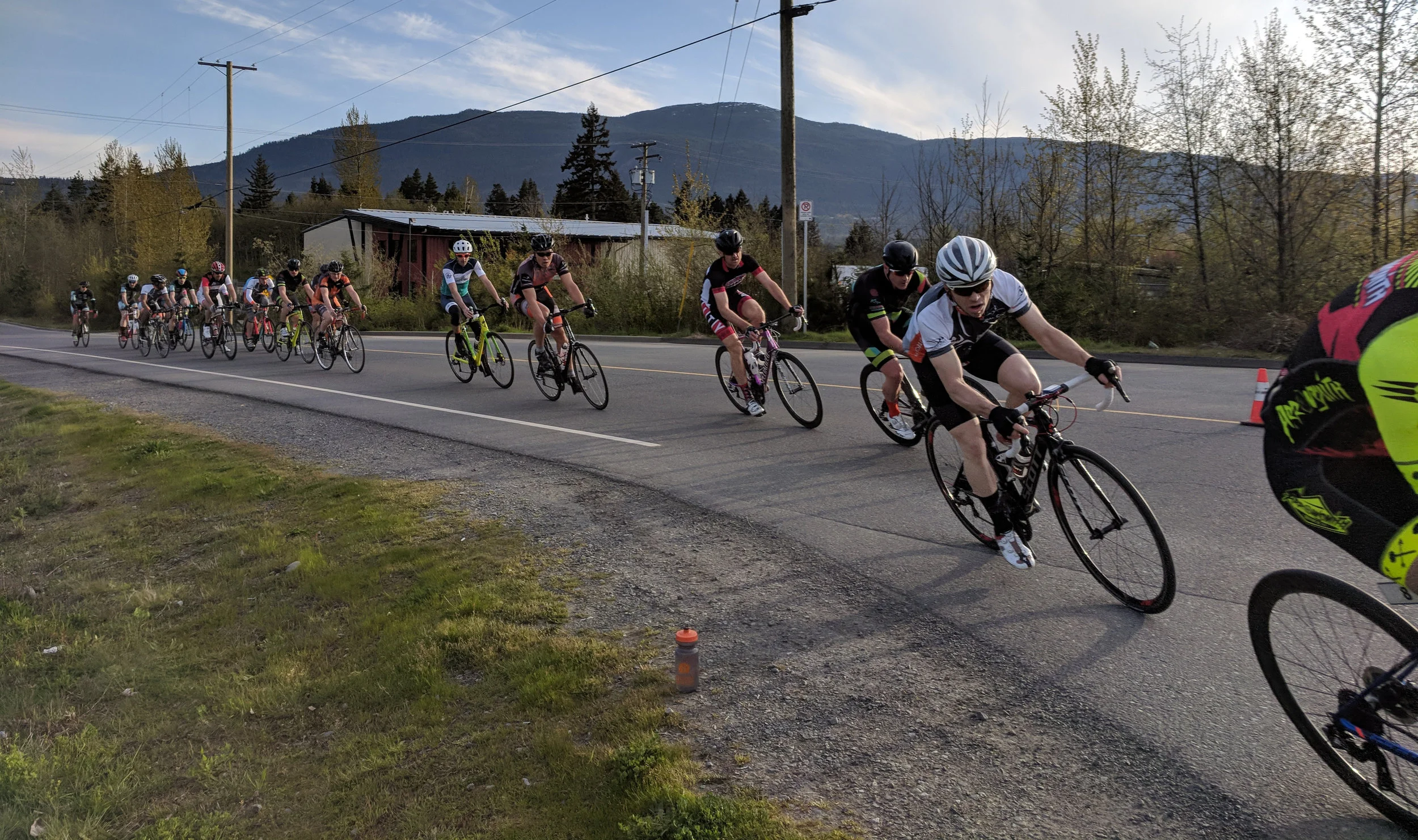
 Over the last year, a number of different strategies have been used to make the club's social rides successful, including advertising a set time day, and start location plus set routes, but so far, the only one that seems to have potential is for club members to advertise their own projected ride on the MIVA Facebook page and include date, time and location of start. The MIVA Board will attempt to come up with alternative plans in the coming season, including riding out to events where other members are racing. Any of our readers who have good ideas about these non=competitive rides,please post in the comments section.
  Here is a good example of a British club out on a social ride Interestingly enough, couldn't find any Canadian examples!).


For a number of years, the Cobblestone Classic criterium took place in Winnipeg and many top riders from Canada and the States took part. This year, MIVA is organising the first, annual, new Cobblestone Classic in downtown Nanaimo as a fully sanctioned Cycling BC event. There will be races for category 1/2, 3,4 and 5 and for women and juniors. The Nanaimo Downtown Business Improvement Association is being asked to lend its support to this exciting event.
This Sunday, a number of the MIVA club members are meeting at the main library to ride around the chosen circuit and discuss possible modifications to provide better spectator viewing and to draw in more support from local businesses.
 Thursday's session features the Sufferfest Angels. If you want some good climbing intervals, this is the one for you. Location is Pleasant Valley Elementary School, Dunbar Road, Nanaimo. &.30pm - 9.30pm.Huge screen and great, loud sound track with lots of visual cues.
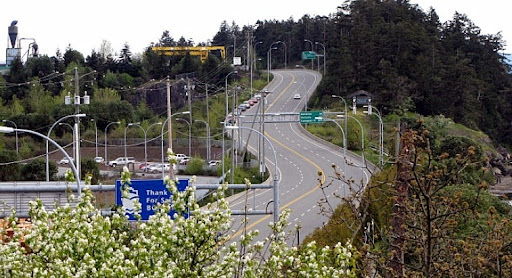 MIVA is applying to the City of Nanaimo for a permit to use the Duke Point Highway for Sunday time trials on March 4th. and 18th. and on April 4th. This may be possible as the Duke Point ferry terminal is closed for repairs until further notice. The April 4th. event may be changed to a 45km road race if there is sufficient interest.
This should be a great opportunity for Island roadies and tri guys to measure their pre-season form on a well-surfaced, traffic-free course. It's not often that you get the opportunity to race on the Trans Canada Highway!
Watch for updates.
 Penny-farthing, high wheel, high wheeler, and ordinary are all terms used to describe a type of bicyclewith a large front wheel and a much smaller rear wheel that was popular after the boneshaker, until the development of the safety bicycle, in the 1880s. They were the first machines to be called "bicycles".
Although they are now most commonly known as "penny-farthings", this term was probably not used until they were nearly outdated; the first recorded print reference is 1891 in Bicycling News.[3] It comes from the British penny and farthing coins, one much larger than the other, so that the side view resembles a penny leading a farthing. For most of their reign, they were simply known as "bicycles". In the late 1890s, the term "ordinary" began to be used, to distinguish them from the emerging safety bicycles, and this term or Hi-wheel (and variants) is preferred by many modern enthusiasts.
Penny-farthing, high wheel, high wheeler, and ordinary are all terms used to describe a type of bicyclewith a large front wheel and a much smaller rear wheel that was popular after the boneshaker, until the development of the safety bicycle, in the 1880s. They were the first machines to be called "bicycles".
Although they are now most commonly known as "penny-farthings", this term was probably not used until they were nearly outdated; the first recorded print reference is 1891 in Bicycling News.[3] It comes from the British penny and farthing coins, one much larger than the other, so that the side view resembles a penny leading a farthing. For most of their reign, they were simply known as "bicycles". In the late 1890s, the term "ordinary" began to be used, to distinguish them from the emerging safety bicycles, and this term or Hi-wheel (and variants) is preferred by many modern enthusiasts.
About 1870, James Starley, described as the father of the bicycle industry, and others began producing bicycles based on the French boneshaker but with front wheels of increasing size, because larger front wheels, up to 1.5 m (60 in) in diameter, enabled higher speeds on bicycles limited to direct drive. In 1878, Albert Pope began manufacturing the Columbia bicycle outside of Boston, starting their two-decade heyday in America.
Although the trend was short-lived, the penny-farthing became a symbol of the late Its popularity also coincided with  the birth of cycling as a sport. There are still many of these unwieldy bikes around the world and a number of enthusiasts actually compete in races. Here is a video of penny farthing races held in Evandale, Tasmania every year.