
| Senior M | Races | Points |
| Menno Jongsma | 4 | 38 |
| Ian Smith | 3 | 34 |
| Ray Wagner | 3 | 27 |
| Marc Wieler | 4 | 26 |
| Nick Kupiak | 4 | 25 |
| Chris Cameron | 2 | 22 |
| Steve Struthers | 3 | 20 |
| Paul Thompson | 2 | 17 |
| Michael Gill | 5 | 16 |
| Mike Sevcov | 3 | 12 |
| Bill McMillan | 4 | 12 |
| Rob Russell | 1 | 10 |
| Steve Crowley | 2 | 10 |
| Shepherd Stewart | 2 | 8 |
| Kyle Waring | 2 | 8 |
| Fred Hodgson | 1 | 6 |
| Evan Earp-Jones | 2 | 5 |
| Shawn Boyd | 1 | 4 |
| Kirby Villeneuve | 1 | 2 |
| Ron Hewitson | 1 | 1 |
| Phil Birrer | 1 | 1 |
| Russell Berg | 1 | 1 |
| John Lam | 1 | 1 |
| Adam McConnell | 1 | 1 |
| Quentin Wicks | 1 | 1 |
| Rob Bau | 1 | 1 |
| Justin Mark | 1 | 1 |
| Youth M | Races | Points |
| Brodie Hay | 4 | 37 |
| James Grant | 3 | 32 |
| Mark Grant | 3 | 28 |
| Andrew Grant | 1 | 1 |
| Senior W | Races | Points |
| Charlene Hay | 4 | 40 |
| Glenda Harling | 2 | 24 |
| Lorrie Baildham | 1 | 12 |
| Janna Gillick | 2 | 12 |
| Katie Wallington | 1 | 9 |
| Youth W | Races | Points |
| Jessica Reynolds | 3 | 36 |
| Mykelti Berg | 2 | 20 |
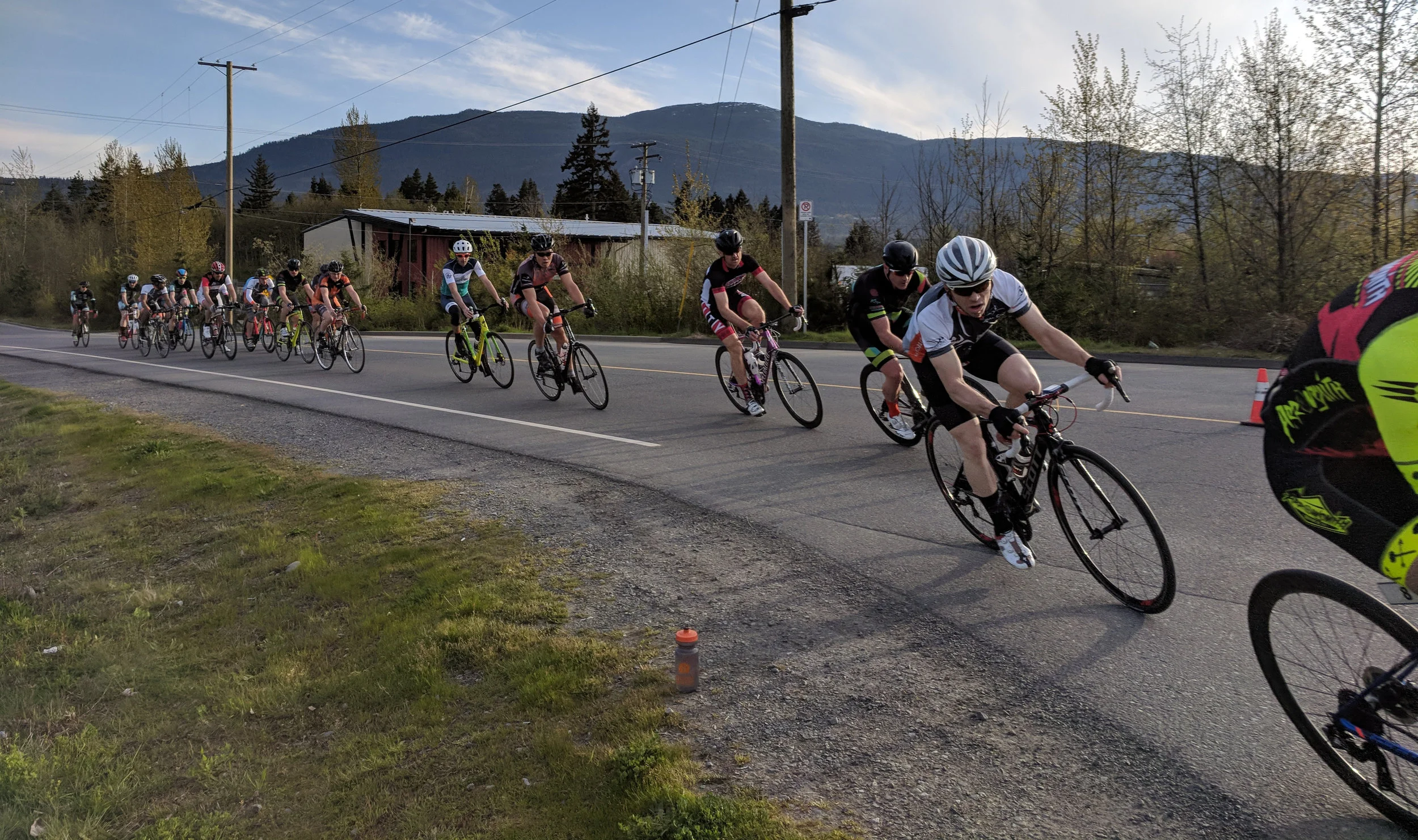
We have all observed or have been part of a group of cyclists. These groups vary from "Monday's washing on the line", where group members are spread out over hundreds of metres, to close, well-organised units that move almost as one, enabling other, faster road users to pass in safety. To help you develop or improve your group riding skills, we reprint the following article without comment. Hopefully you will all learn something from it. Ed.
The essence of group riding is riding the paceline. It allows cyclists to travel faster with less effort and provides a better social experience. (It is also a foundation of racing.) Pacelines do have some inherent danger and require communication among the riders. But a good paceline is a wonderful thing.
The basic SINGLE paceline is simple. The riders align behind one another to take maximum advantage of the "drag" effect of the cyclists to the front. The cyclist in the front will set the group's pace, when the lead rider decides it is time to change, that rider pulls off to one side and drifts back to the end of the paceline.
The new lead cyclist increases effort SLIGHTLY (just increases the amount of pressure on his pedals) to maintain the group pace. A good paceline is smooth. A good paceline is built on trust. The riders have to be confident that the others in the group will communicate well and ride safely.
TYPES OF PACELINES
| Single | Double | Rotating | Echelon |
 |
|||
Which direction should the lead rider pull off? The single paceline picture above shows the rider pulling off to the left. But there are various reason to pull off either direction. If there is a cross wind the lead rider will pull off whichever direction the wind is coming from. This is because the riders in the single paceline will naturally line up as shown in the "echelon" picture to hide themselves from the wind. Some believe that the rider coming off the front and going backwards should not be in the lane of car traffic and should, as a general rule, pull off to the right. Basically, whichever direction the group is using, all riders should do the same thing.
The DOUBLE paceline is a minor modification of the single paceline. In this setting there are just two single pacelines side by side. The riders on the front of each paceline pull off in opposite directions. As a general rules, the pacelines are far smoother if the two front riders agree and pull off simultaneously. Otherwise, one of the lines has to surge to get the front riders side by side.
A ROTATING paceline requires more focus and greater skills but is very satisfying to be part of. In a rotating paceline there is an advancing (faster) line of riders and a retreating (slower) line of riders.
The retreating line is on whichever side the wind is coming from. If it is a headwind a tailwind or no wind, usually the retreating line will be on the right side and the advancing line will be on the left. (The opposite of the picture above).
The key to a rotating paceline is that when the rider at the front of the advancing line clears the rider who is on the front of the retreating line, the advancing rider moves into the retreating line and softens up his pace. The rider who was behind him continues the pace of the advancing line until that rider switches over. The rider in the advancing line should NEVER surge. The idea is that you ride to the front and float to the back in a constant rotation. You change your speed by "soft-pedaling" as you switch to the retreating line and increasing your pedal pressure as you switch from the retreating line to the advancing line.
Smooth switches, and keeping the distance between the riders in the paceline as small as possible will keep the paceline smooth.
An ECHELON is a paceline ridden in a crosswind. The riders will naturally find cover at an angle as shown above. An Echelon can refer to either a single paceline or a rotating paceline. In either case, the lead rider will pull off INTO the wind.
| Chris Cameron | MIVA | 12 |
| Ian Smith | MIVA | 10 |
| Menno Jongsma | MIVA | 9 |
| Steve Struthers | MIVA | 8 |
| Mike Sevcov | Everti/MIVA | 7 |
| Nick Kupiak | MIVA | 6 |
| Shepard Stewart | MIVA | 5 |
| Shawn Boyd | MIVA | 4 |
| Steve Crowley | MIVA | 3 |
| Marc Wieler | Arrowsmith | 2 |
| Adam McConnell | MIVA | 1 |
| Bill McMillan | MIVA | 1 |
| Phil Birrer | MIVA | 1 |
| Mike Gill | MIVA | 1 |
| Glenda Harling | Everti/MIVA | 12 |
| Charlene Hay | MIVA | 10 |

Another great night for the MIVA time trial series, and another great turnout! A total of 15 riders came out to ride the 40km course tonight, with some (Chris Wilberg) even coming from the mainland just to ride the TT. That bodes well for future attendance this year as the well established MIVA TT Series is attracting riders from all over. After 4 races in 2013, we have had 67 racers out already. At the same time last year, we had 35 racers out. A 91% increase already, with many regulars who haven't missed a race yet.The youth race was a 20km and was well attended by regulars Abigail Hare, Ian Gilmore, and Aiden Hare. All 3 rode hard on the challenging course, and Aiden put down an amazing time of 46:53, shaving over a full minute off of last weeks time!

The female division was won by Rose Houle in 1:14:10, with 2nd place going to Sarah Davidson, who is fresh off a fast half marathon time and should keep getting faster and faster times as the season rolls on.

In the mens division, Don Gilmore won his 4th consecutive TT of the season with a very fast 58:29 over the 40k distance. Taking 2nd place was Chris Wilberg in 1:05:56, and third place being Reagan Lovig with 1:08:21. Mr.Fixie himself, Patrick Burnham, rode out splits of 34:45/34:46 , BOTH of which were faster than his 20k alone last week, very impressive! The rest of the field all came charging in with solid times, well done Angellos Glaros, Glen Gordon, Paul Callow, John Tillie, Jason Hare, and Mark Weiler.

All of the results can be found HERE via Webscorer. Great stats on there for those of you who want to see your average speed, as well as lap splits!
The winner of the MIVA socks tonight was Patrick Burnham, wear your MIVA kit and you have a good shot at free stuff!
NEXT week's TT is a 15k, same time, same place.

Short video of Don Gilmore's finish IMG_4182