
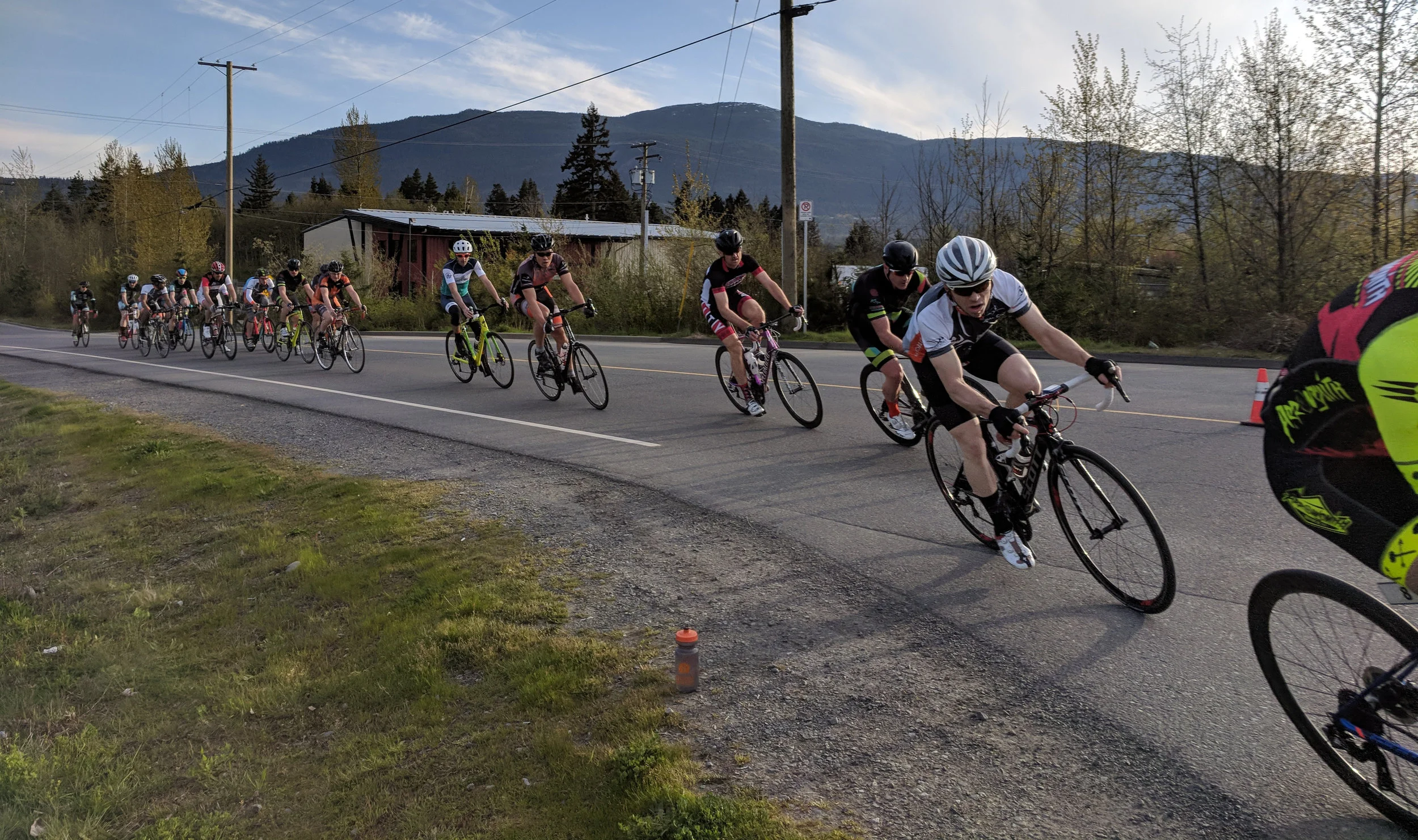
 While participating in last Thursday's MIVA bike trainer workshop, you editor was fascinated by the wide range of cadences observed. Some riders mashed large gears at 50 - 60 rpm, some twiddled very small gears at up to 125+ rpm, and still others used their gears to maintain in-between cadences of 85 - 100rpm. Having a little experience in these matters, editor started to write an article on how to choose cadence but, while googling for some wiser words on the subject, found the following excellent piece from "Beginning Triathlete
Cycling Cadence
The physics and physiology of high and low cadence cycling. Both low and high cadence work are useful for increasing your “cadence comfort,” or your comfort within a wide range of cadences.
While participating in last Thursday's MIVA bike trainer workshop, you editor was fascinated by the wide range of cadences observed. Some riders mashed large gears at 50 - 60 rpm, some twiddled very small gears at up to 125+ rpm, and still others used their gears to maintain in-between cadences of 85 - 100rpm. Having a little experience in these matters, editor started to write an article on how to choose cadence but, while googling for some wiser words on the subject, found the following excellent piece from "Beginning Triathlete
Cycling Cadence
The physics and physiology of high and low cadence cycling. Both low and high cadence work are useful for increasing your “cadence comfort,” or your comfort within a wide range of cadences.
Physics The work required to move a bike down the road is measured in watts. To define it very simply:
Watts = Torque x Cadence, where Torque = Force x Distance; or how hard you press on the pedals multiplied by the number of times per minute you apply this force.
Two cyclists, Bob and Bill, weigh the same, have identical bikes, identical aerodynamics and are riding next to each other at the same speed on a flat road. Because they are riding the same speed and we’ve controlled all the other variables, they are performing the same work, ie, riding at the same watts. However, Bob is mashing at 70rpm while Bill spins at 110 rpms. Bob’s pedaling style dictates that he press hard on the pedals with each stroke. But he does so less frequently than Bill, who is pushing lightly on the pedals but much more frequently.
Physiology Low cadence cycling requires us to push harder on the pedals, but what does this mean at the level of our leg muscles? To generate that higher force contraction, your leg muscles must recruit more fast-twitch muscle fibers vs slow-twitch fibers.
Slow-twitch fibers:
Primarily burn fat for fuel, an almost limitless supply of fuel for even the leanest athlete.
- Are very resistant to fatigue: they are built to go and go, all day.
- Recover quickly when allowed to rest.
Fast-twitch fibers:
- Burn glycogen for fuel. This glycogen is stored within the muscles and is in relative short supply, about 2000 calories for a well-trained, well-fueled athlete.
- Fatigue quickly, are NOT built to go all day.
- Take a long time to recover before they can be used again.
Matches
CyclingPeaksSoftware.com developed this analogy. I think it’s a good one, but I like to elaborate a bit. Imagine your legs are a book of slow and fast burning matches. The purpose of training is to increase the size, number and flavor (ratio of slow and fast) of your matches, depending on the demands of the race. Sports requiring short bursts of speed favor athletes with lots of fast matches. Endurance events favor slow matches. You can use either match to do the work of racing but the total number of matches in the book is finite. And once you burn a match, it’s gone - you can’t get it back.
Now, back to our discussion of cadence. You are riding on a flat road, approaching a hill that will take you about a minute to climb. You will likely do one of four things:
1. Shift to a gear that feels comfortable and/or powerful for you. You feel good when you climb at 60-70rpm so you do that, shifting to the middle of the cassette
2. Climb at 60rpm since you showed up to the ride with a 21-11 rear cassette
3. Say “The hill will only take me a minute to climb. I don’t want to lose any speed so I’ll hop out of the saddle, stand up and hammer up the hill. I’ll recover on the decent.”
4. Shift into your 25 cog and spin up the hill at 85-90rpm
Option #1: Low cadence = high force = high fast twitch recruitment = burning matches that you may need towards the end of the run. Forget “feels” powerful. Power is watts to the wheel, period. If you can climb a hill at the same speed (equal watts) at 60rpm or 90rpm, choose 90rpm. Conserve your fast twitch fibers so you can recruit them later in the run.
Option #2: See Option #1 and always bring enough gears to the race. In my experience, the only people who attach sexual competency issues to the gearing on their bike are folks who don’t climb. I have (no lie) six cassettes hanging in my garage that I swap on and off my bikes according to the terrain of the ride. I have everything from a 27-12 to a 19-11. You can flatten any hill if you have enough gears on your bike J.
Option #3: Standing = power spike = high fast twitch recruitment = you know the drill. From riding with a powermeter for many years I can tell you that if you don’t have a meter it is VERY difficult to stand in the saddle and not toss out huge watts for a brief amount of time. It might “feel” ok, but chances are very high that you just burned a few matches with your little burst.
Option #4: Bingo! Spin up the hill, burn slow, not fast matches so you can use those matches on the run, burning the last one as you cross the finish line.
What is the optimal cadence?
Ok, so I’ve sold you on the value of high cadence vs low cadence. But what is the optimal cadence? In my experience, most athletes should ride at a cadence of 88-95+ rpm.
A few notes here:Notice that this cadence is right in line with an optimal running cadence. I believe it is hard to run off the bike at 90+ rpm if you’ve been cycling for hours at 80rpm. You’re asking your legs to make a huge adjustment, in addition to the difficulty of transitioning from cycling to running.
- More experienced and stronger cyclists will be comfortable within a wide range of cadences. When I began cycling, anything under 88rpm felt like mashing, while 95+ felt too fast. I was always searching for that right gear. Now, after many, many miles, I can ride equally comfortably at 78-82 or 100-105. My tool kit is much larger (see below).
Cadence and Training
Some coaches prescribe low cadence intervals as a method to train your body to push harder on the pedals. However, consider the importance of specificity: if you want to run longer, run longer; if you want to swim faster, swim faster; if you want to ride the bike farther, ride the bike farther. If you want to ride the bike faster at 92rpm, then ride the bike fast (high watts, ie greater work output) at 92rpm.
Having said that, both low and high cadence work are useful for increasing your “cadence comfort,” or your comfort within a wide range of cadences. By this I mean you have strong, resilient, well-adapted legs that can handle a broad range of cadences, including that high force/high wattage contraction that may happen if you run out gears, decide to climb out of the saddle, etc. You have a large tool kit to handle a broad range of conditions.
The most common tool is a period of low cadence intervals fitted into the early season. My guidance:
- beginner: useful tool early season for developing sport-specific strength and “cadence comfort” quickly in their cycling careers.
- Intermediate: useful early season, see above. However, after 4-6 weeks of low cadence intervals, transition to lactate threshold intervals at normal, time trial cadence. Reserve low cadence for fartlek-style training - grind up a hill at random to build or retain this cadence comfort.
- Advanced: high watts at race specific cadence is more useful. These athletes have already developed cadence comfort and a period of low cadence intervals is, I believe, often an unnecessary step. I reserve low cadence work for:
- Fartlek, see above.The last hour of long rides, to force recruitment of fast twitch fibers when they are already on the edge.
- Athletes training with power: the ability to measure watts while cycling at very low cadences creates possible exceptions to this guidance. The power-training athlete can truly turn his bike into a piece of gym equipment and is, I believe, more justified in adding low cadence intervals to his training routine.
In summary:
- Focus your training to develop speed (wattage) at your race-specific cadence - the cadence you plan to race at. My suggestion is 88-92+ rpm, with weaker, less experienced cyclists targeting the high end of this range.
- Supplement this race-specific training with informal low cadence/out of the saddle work to build this resiliency above and expand your range of comfortable cadences. See my guidance above for how to build low cadence intervals into your particular training season.
- Bring the proper gearing to the race! And when in doubt, bring more gears! I think a compact crank is an excellent tool for all cyclists to consider.
- Bring these fast, strong, resilient legs to the race. Put them on a bike with the proper gearing. Exercise smart, disciplined pacing and climbing skills to limit the number of matches you burn on the bike course, burning that last match at the finish
".

 Kirkpatrick MacMillan's prototype bicycle was propelled by a horizontal, reciprocating movement of the rider's feet, similar to children's toy cars . The movement was transmitted to cranks on the rear wheel by connecting rods and operated like the rods connecting the wheels on a steam locomotive. The machine was extremely heavy and the physical effort required to ride it must have been considerable.
 MacMillan never thought of patenting his invention or trying to make any money out of it - but others were not slow to realize its potential! Soon, copies began to appear for sale. Gavin Dalzell of Lesmahagow copied MacMillan's machine in 1846 and thereafter gave the details to so many people that for more than fifty years, he was generally regarded as the inventor of the bicycle.
 Thomas McCall, who had seen MacMillan on his way to Glasgow, upgraded the bicycle with brakes and other improvements. In the mid 1880's he was the first to sell bicycles commercially from his workshop in Kilmarnock. He declined any recognition for his inventions and, like MacMillan, never took out any patents.
 Mid Island Velo members should now renew their memberships for 2012. The club is applying for support from Bingo and Casino revenues for 2012 and it is important that the membership numbers should be at least as high as in 2011. 2012 membership forms can soon be downloaded from the "membership" page.